Scout Report
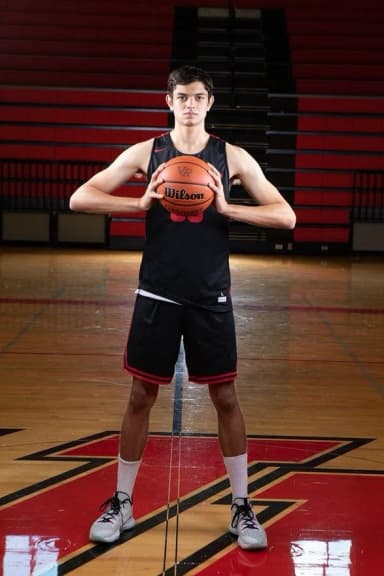
Share a lineup with a Big East center and an ACC point guard and the question changes. Nobody asks whether a player belongs in the gym. They ask what he does when the ball finds him. That is the situation Elliot Erickson, a 6-foot-6 wing in the 2027 class, has stepped into.
Background
Public detail on Erickson's path is thin right now. His current school is not listed, and there is no verified information on his hometown, family, or AAU affiliation, so none of that gets guessed at here. What can be said is that he is a junior-class wing sharing a roster with Theo Edema, a 2026 center ranked #109 who is committed to St. John's, and Ryan Moesch, a 2026 point guard ranked #151 who is committed to Syracuse. Those are two high-major signees on the same team. Competing for touches and minutes with players like that is a real test, and it also puts Erickson in front of the coaches who come to see them. The rest of his background will fill in as his recruitment picks up.
Playing Style
Without verified tape or box scores to lean on, the read starts with the profile itself. At 6-foot-6 playing the three, Erickson has the size to guard multiple positions and to see over most defenders on the perimeter. Next to a ball-dominant guard like Moesch and a rim presence like Edema, his role this season almost certainly leans toward connective work. That means spotting up, cutting off the ball, attacking closeouts, and making the quick second or third pass. Wings who play that way tend to be judged on decision speed, not volume. Do the right thing fast, and the offense keeps its rhythm. Defensively, the same logic applies. A 6-foot-6 body flanking a center and a point guard gets asked to rotate, take the best opposing wing, and rebound out of his area. How he handles those jobs, especially his effort and positioning away from the ball, is what evaluators should track. A full, honest breakdown of his tempo and shot profile needs live viewing, and nothing here pretends otherwise.
Strengths
The clearest asset is positional size. Six-foot-six is a useful height for a small forward, big enough to contest shots and finish through contact, and still within the range where a player can handle and shoot on the perimeter. Playing in a rotation with two committed Division I players also means he is regularly facing high-level competition in practice and games, and that tends to speed up a wing's development. Coaches evaluating him will want to see how he uses that size. Does he rebound in traffic? Does he make plays on the second side of the floor? Those are the details worth watching on tape.
Areas to Watch
The biggest gap right now is information, not a flaw. There are no reported offers, no stat line, and no public film notes to measure him against his class. For Erickson, the next step is to turn a good situation into visible production, whether that is a defined skill like shooting off movement or on-ball defense against bigger guards. Summer events and early-season games will matter, because a junior with no offers needs coaches to see a clear, repeatable strength.
Player Comparison
There is not enough verified information on his game to attach a responsible NBA or college comparison, and forcing one would mislead readers. Once film and shot data are available, a comparison can be built around how he scores and defends, not just his height and position.
Recruitment
Erickson has no reported offers at this stage, and nothing suggests a commitment is close. That is not unusual for a 2027 prospect in the fall of his junior year, when many wings are still waiting on spring and summer evaluation periods. His teammates Edema and Moesch have already drawn high-major interest, so coaches are in the building, and some will notice the 6-foot-6 wing playing next to them. The first offers, if they come, would likely arrive after a strong winter or a productive summer circuit. Projecting a landing spot now would be speculation. The more honest read is that his recruitment is wide open.
Projection
The range of outcomes is wide because the public record is short. A wing with his size who develops a reliable perimeter shot and holds up defensively can fill a real rotation role in college, probably as a two-way connector. If the skill set stays modest, a mid-major or lower-level Division I path is more realistic, and that is still a good outcome for a player not yet on the national radar. The pro question is too early to answer, and it depends on how much he grows as a shooter and a decision-maker over the next year.
Updated Oct 24, 2026 · Analysis by PrepRadar Scouting Team
Social Activity
Colton Helton (@Coltonhelton23) is the definition of a blue-collar stud, a versatile competitor who impacts games in ways that don’t always scream for attention but always show up on the scoreboard and in the win column. Some nights it’s scoring, every night it’s the boards, the https://t.co/AxULn2udYS
Happy Birthday @SteveHelton44 hope you enjoy your day and that you know that you are a blessing to our family. Love you ❤️🎁🎂🥳🎊 https://t.co/h27xbE4OFx
@corey_flinchum had 41 pts, 8 rebs, 3 stls, 2 assts and 1 blk vs. a really good powell county team! Was 12-14 from the line. https://t.co/SIAjVHqnUs
Stream. Scroll. Surf. Get speeds up to 400+ Mbps to connect with friends and family without delays.